Occupational safety

Our service is your safety!

Why is occupational safety important?

Occupational safety is the totality of safety and health requirements relating to organized work, supported by a system of legislative, organizational, and institutional regulations.

Therefore, the purpose of occupational safety is to provide all employees with a safe workplace that is not harmful to their health and protects their physical integrity. Regardless of the occupation, it is essential to prevent illnesses and accidents at work, which is aided by occupational safety and security regulations. The aim of occupational safety is also to ensure that the machines, equipment, and tools found and used in the workplace are safe from an occupational safety perspective, based on occupational safety legislation. All of this is independent of the organizational or ownership forms of the work.

Occupational safety tasks may only be performed by persons who are specialized in this field.

Professional

Occupational safety document/year

Occupational safety inspection/year

Occupational safety

Our occupational safety services

Flat-rate occupational safety service

Our occupational safety experts has more than 25 years of experience, which we have utilized and relied upon to develop our IT audit system. Our occupational safety services Within this framework, we regularly conduct fire and occupational safety inspections and screenings on our clients' premises. Our flat-rate occupational safety service includes:

  • occupational safety inspection and screening,
  • consulting,
  • preparation of occupational safety documents,
  • occupational safety training (e-learning or in person, in multiple languages),
  • thorough investigation of accidents at work
  • representing our partners during official inspections.

Within the framework of occupational safety services, we regularly conduct fire and occupational safety inspections and audits on our clients' premises in accordance with our IT audit system, which has been developed based on more than 25 years of experience.

We record any irregularities observed during on-site inspections and our recommendations for necessary measures in the web-based software we have developed. The purpose of the software was to manage fire and occupational safety tasks and monitor their timeliness. This program allows for the recording and inheritance of findings that are found to be compliant and regular, as well as those that are found to be non-compliant and deviating from the law, until the date of correction. It is suitable for the immediate and coordinated recording of findings made during the inspection. After the task is completed, the program automatically generates a PDF report containing the findings that are considered compliant and non-compliant. This PDF report can be sent to our partners immediately from the site.

Fire and occupational safety inspections are carried out monthly, quarterly, semi-annually, or annually, as agreed, but we are also prepared to perform daily tasks upon separate agreement.

We provide preliminary advice and assist with obtaining official permits for the construction or leasing of new premises, or the conversion of new or existing premises.

As part of our occupational safety services, we make recommendations for improving occupational safety to the required level, for further justified increases, and for eliminating deficiencies identified and reported in writing during inspections.

We prepare the necessary occupational safety documents (operating logs, occupational safety regulations, risk assessment, medical examination procedures, personal protective equipment allocation procedures, training materials and topics). .

We will continue to provide training for new employees and annual fire and occupational safety training (using an e-learning system as needed).

We thoroughly investigate and record all work-related accidents that occur at our partners' premises, and assist in reporting them to the authorities. We provide 24-hour availability in the event of serious accidents and in relation to immediate reporting and investigation obligations (serious, mass, fatal accidents).

Risk assessment

Risk assessment is a fundamental part of occupational safety. Risk assessment service for companies, according to which employers, in compliance with their obligations under the Occupational Safety Act, must have a risk assessment in place in which they are required to assess, qualitatively and, where necessary, quantitatively, the risks to the health and safety of employees, with particular regard to the work equipment used, hazardous substances and mixtures, the stresses affecting employees, and the design of workplaces.
Risk assessment is a key element of the measures taken by employers to prevent accidents at work and occupational diseases, as well as cases of increased exposure, in order to ensure safe working conditions that do not pose a threat to health.

Risk assessment is nothing more than the examination and auditing of a workplace, work process, and the tools used in the work process.

Risk assessment is considered a specialized activity in occupational safety and health.The employer may entrust the risk assessment to a designated occupational safety and health specialist employed in accordance with the Occupational Safety Act. The occupational health service provider and the occupational safety specialist shall prepare the risk assessment in cooperation with each other and certify it with their signatures.

Unless otherwise specified, the employer is required to perform risk assessment, risk management, and determine preventive measures before commencing activities, and thereafter in justified cases, but at least every three years, in accordance with the provisions of the Occupational Safety Act. Justified cases include:

  • changes in the activities, technology, work equipment, or working methods used;
  • any change related to the original activity that may have resulted in a change in the working conditions affecting the health and safety of employees, including changes in the working environment, noise, vibration, air conditions (changes in the quality or quantity of gaseous, dust, or fiber air pollutants);
  • work accidents, increased exposure, or occupational diseases occurring in connection with deficiencies in the activities, technology, work equipment, or work methods used, and,
  • if the risk assessment did not cover the criteria specified in separate legislation.

Risk assessment must be documented in all cases, even if, during the assessment and evaluation, experts conclude that the measures taken ensure safe working conditions that do not pose a threat to health.

There are no formal requirements for the documentation prepared as a result of the risk assessment, but in terms of content, at least the following must be recorded:

  • the date, location, and subject of the risk assessment,
  • the identification details of the person conducting the assessment;
  • identification of hazards;
  • identification of those at risk and the number of people affected;
  • factors aggravating the risk;
  • qualitative and quantitative assessment of risks and determination of whether the circumstances comply with occupational safety regulations and whether risks are kept at an acceptable level;
  • the necessary preventive measures, the deadline, and the designation of responsible persons;
  • planned date for the next risk assessment;
  • the date of the previous risk assessment.

The employer must retain the document for at least 5 years.

The employer must ensure that employees are familiar with the results of the risk assessment and have access to the documentation at any time.

Occupational safety training

Occupational safety training is an important part of occupational safety, under which the employer must ensure that their employees learn and, throughout their employment, know and apply the most important fire safety rules and local safety practices at a skill level. Always be aware of the rules and instructions necessary for or related to your work.

The existence of occupational safety regulations and documents is mandatory for business organizations under occupational safety rules. In the case of both fire protection and occupational safety, the preparation of essential regulations and documents is considered a specialized activity. The fire protection regulations, the occupational safety risk assessmentoccupational safety training topics, The availability of personal protective equipment, fire safety and occupational safety documentation, legal harmonization, and up-to-date status are strictly monitored.

In order to meet these conditions, employees must receive occupational safety training:

  • when starting work,
  • when there is a change in workplace or job description, or when there is a change in the requirements for safe working practices that do not pose a risk to health,
  • when modifying work equipment or putting new work equipment into service,
  • when introducing new technology.

Occupational safety training must be held during working hours and repeated at specified intervals.

Preparation for occupational safety inspections

We prepare for occupational safety inspections and check the availability and compliance of documents required for occupational safety inspections. If any documents are missing or non-compliant, we make recommendations for the necessary documents replacement. Upon request, we will prepare it for official inspection within a short period of time.
During the comprehensive inspection of the facility and the on-site inspection, we check compliance with occupational safety regulations.
We prepare a report on the deficiencies identified during the site visit and the necessary measures to be taken.

We prepare you for occupational safety inspections by checking that you have all the necessary documents and that they are in order. If any documents are missing or out of order, we will recommend what needs to be done to rectify the situation. Upon request, we can prepare you for the inspection at short notice.

During the comprehensive inspection of the facility and the on-site inspection, we check compliance with occupational safety regulations.

We prepare a report on the deficiencies identified during the site visit and the necessary measures to be taken.

If required, we represent our client during official inspections!

Home office risk assessment

With our new software, specially developed for home office risk assessment, you can check an employee's home workstation in as little as 10 minutes, while also providing related fire safety and occupational safety training. No personal contact is required, so using the software also helps to prevent the risk of infection caused by the Covid pandemic.

Conducting a risk assessment of home offices is both an occupational safety and labor law obligation for employers. The labor law rules governing remote work are set out in Act I of 2012 on the Labor Code, while the occupational safety rules are contained in Act XCIII of 1993 on Occupational Safety.

The provisions of these two laws must be applied taking into account the specific characteristics of working from home. It is the employer's responsibility to ensure safe working conditions that do not pose a health risk, even in the case of remote working (home office), so the Occupational Safety and Health Act imposes occupational safety obligations on employers with regard to working from home. The main focus of this is a risk assessment prior to the modification of the work or the employment contract, which verifies the conditions for safe work. (Ref.: Mvt. 86/A. § (3) paragraph.)

The employer must conduct a risk assessment of the working environment created by the employee in terms of home office. Following a successful audit, but before the employee starts working from home, they must also receive occupational safety training. Both the risk assessment and the preparation of the training material require the involvement of a person with occupational safety qualifications.

Our employees have decades of experience in assessing the risks of working from home and in occupational safety trainingin preparing the curriculum. With our newly developed and tested online audit system and the associated e-learning We quickly and efficiently fulfill employers' occupational safety obligations related to remote work through training. For those of our partners who require traditional on-site audits to check the conditions of working from home, we continue to provide the usual high-quality service throughout the country.

The employer must conduct a risk assessment of the working environment created by the employee in terms of home office. Following a successful audit, but before the employee starts working from home, they must also receive occupational safety training. Both the risk assessment and the preparation of the training material require the involvement of a person with occupational safety qualifications.

Our employees have decades of experience in assessing the risks of working from home and in occupational safety trainingin preparing the curriculum. With our newly developed and tested online audit system and the associated e-learning We quickly and efficiently fulfill employers' occupational safety obligations related to remote work through training. For those of our partners who require traditional on-site audits to check the conditions of working from home, we continue to provide the usual high-quality service throughout the country.

First aid course

An important element of occupational safety is the existence of first aid training courses. Every workplace and shift must have first aid equipment or a first aid kit, depending on the hazards of the activity and work processes and the number of people working there, and a trained first aid officer must be present.
We provide basic first aid training for our clients. e-learning on our website or in person, during which employees can acquire the necessary knowledge through theoretical and practical training.
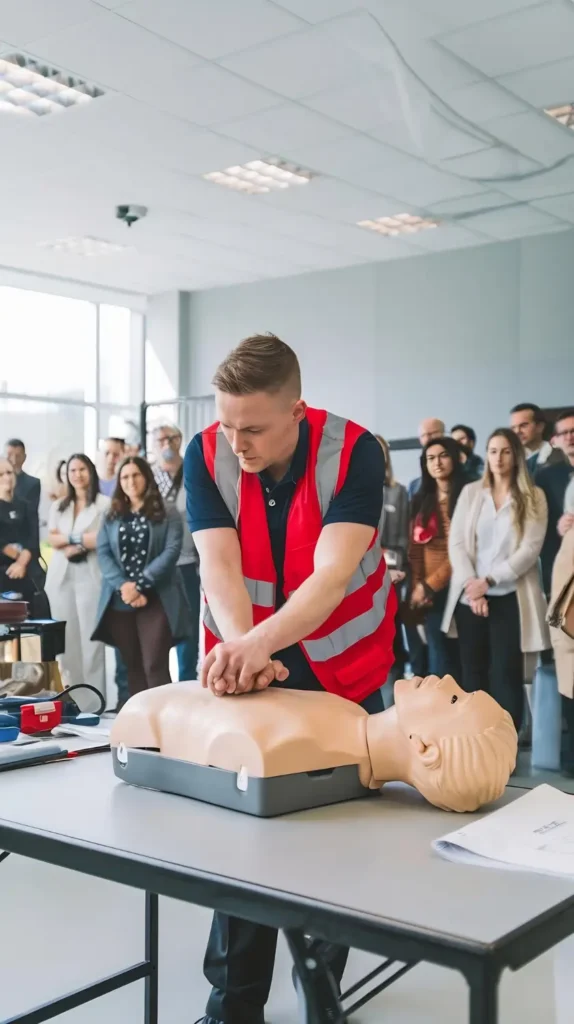

We provide basic first aid training for our clients, during which employees can acquire the necessary knowledge through theoretical and practical instruction.

We support our clients by providing first aid training, as every workplace and shift must have first aid equipment or a first aid kit tailored to the hazards of the activities and work processes, as well as the number of employees working there, and a trained first aid officer must be present.