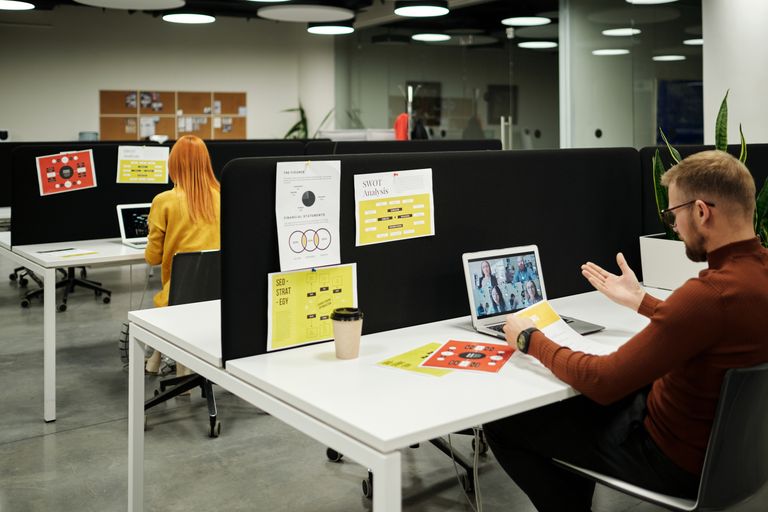
Returning to the office - why is it happening and why does it bring new risks?
The trend: many companies are calling back to the office
During the pandemic, home office (teleworking) became widespread, with many organisations moving to hybrid or fully remote working. Recently, however, more and more large companies have been requiring employees to return to the office at least part-time: for example, McKinsey estimates that by 2024-2025, many organisations will have tightened their RTO policies. McKinsey & Company
Forbes also points out that many companies are choosing to re-hire employees in order to strengthen office collaboration and culture - although this is often accompanied by internal debate and resistance. Forbes
However, it is worth noting that the hybrid model has remained stable in many countries: according to Gallup surveys, hybrid working has not fallen dramatically and many workers prefer flexibility. Gallup.com+1
Why does this bring new occupational safety and health risks?
Getting back to the office is not just a logistical issue - new types of accident and health hazards may arise that were previously less relevant or could be dealt with differently. Here are some examples:
- Increased accident potential: office environment, traffic areas, stairs, paving, slip-and-fall accidents - these are already present in „normal” workplaces as an element of absence. If many people arrive at the same time, crowding, use of doorways, corridors - these can increase the chances of an incident.
- Managing equipment, tools: office equipment, cables, desks, edges - these can be damaged during reset, conversion, maintenance.
- Ergonomic load: if you work in an office for a long time without proper ergonomic adjustment (chair, monitor, standing/changing chairs, etc.), you may suffer from musculoskeletal problems.
- Transport and travel risks: if you drive from home, the chances of an accident on the road increase.
- Complexity of workplace scenarios: e.g. internal logistics (transport, moving documents), maintenance work may be returned at a higher rate.
- Congestion, traffic situations: many entrances/exits, dining rooms, kitchens, use of common areas - these can increase contact and the potential for accidents due to inattention.
- Stress, burden of recovery: a full reset may entail mental health risks (more stress, less resilience), which may indirectly contribute to lack of attention, accidents. One study has shown that full return can lead to higher stress, which can reduce well-being in the long term. PMC
So it's not enough just to recall people - you need to be very conscious of health and safety.
What to do - how to reduce new risks?
1. Recent risk assessment for the office environment
The same methods that were designed for the home office may not be sufficient when returning to the office environment. Special attention must be paid:
- entrance, corridors and walkways
- moving vehicles (e.g. goods transport, internal transport)
- common areas (kitchen, dining room, toilets)
- stairs, railings, floors
- lighting, cabling
- daily operational maintenance tasks, cleaning and upkeep
2. Amended Health and Safety at Work Regulations
When office work returns, the health and safety policy should be amended to cover the new circumstances, with responsibilities, processes and substitutions.
3. Education, training
Training to adapt to the new situation is key: returning workers need to be familiarised with the rules of the road and internal traffic routes. It is also important to raise awareness of ergonomics, movement and breaks.
4. Monitoring, audit and feedback
Accident incidents should be continuously monitored and corrective action taken. Internal audits, feedback systems can be used
5. Flexibility and transition phase
The return does not necessarily have to be quick or radical - the success of many organisations depends on how they introduce change (e.g. phasing in, partial office days, choice). McKinsey argues that the policy itself is less important than the practices that support it (e.g. infrastructure, communication, environment design) McKinsey & Company
Why seek expert help?
- Because the return process means a new situation: it is not enough to „carry over” the old risk assessments.
- We can help with a fresh risk assessment, a newly updated code of conduct, specific training modules (awareness training for office workers) and by setting up a monitoring system.
- So you can concentrate on the core business while we make sure that returning to the office does not bring greater risk to employees and the company.