The occupational safety authority's inspection findings for 2019
In March of this year, the Occupational Safety Department of the Ministry of Innovation and Technology published its report on the findings of its 2019 inspections.
The labor protection authority carried out its inspection activities in accordance with the 2019 Inspection Guidelines, the National Authority Inspection Plan, and its own work plan.
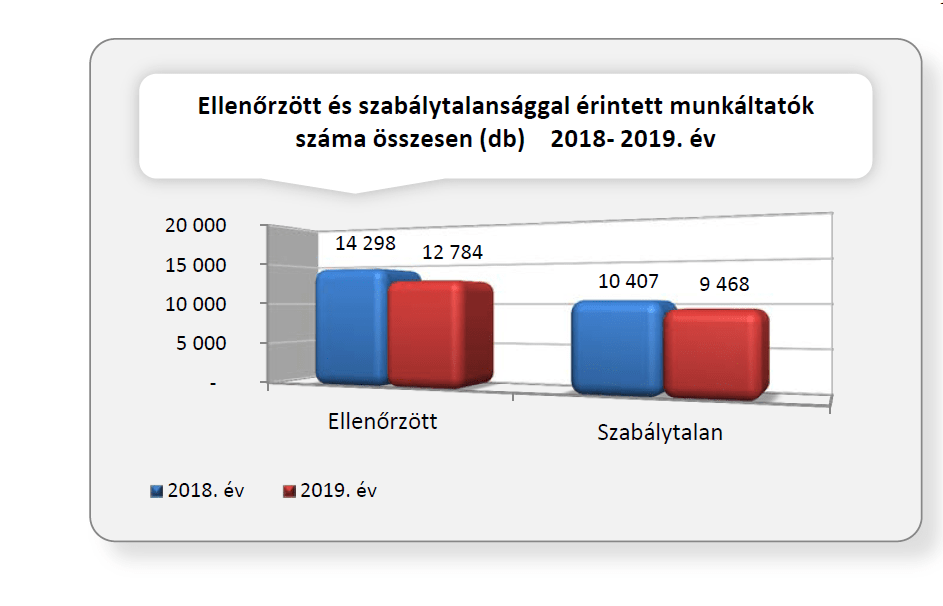
In 2019, the Occupational safety inspections by the authorities covered 12,784 employers., during which government officials checked compliance with rules on safe working practices that do not pose a health risk.
The number of employers inspected and found to be in breach of regulations, compared with 2018 figures, is shown in the figure below:
Government officials during inspections The working conditions of 188,337 employees were examined.. The employers examined during this period were typically smaller companies. Irregularities were found in 66.41% of the employees audited (125,058 people).
Workers employed under irregular conditions 29.1% - serious irregularityaffected.
As a result of the inspections, a total of 18,078 occupational safety decisions was born. Immediate action was taken in 8,189 cases involving situations posing an immediate risk of accident, and 9,265 decisions were made to remedy deficiencies.
In 2019, during the sanctioning process 448 cases of occupational safety, 157 cases of administrative fines, In 119 cases, procedural fines were imposed. government officials.
Occupational safety fine: 197,498,670 HUF, administrative fine of HUF 4,784,000 and procedural fine in the amount of HUF 1,330,000 imposed...
3.5% of substantive occupational safety decisions resulted in financial penalties.
One indicator of the effectiveness of occupational safety measures is the proportion of employers who implement their decisions. In 2019, labor protection authorities conducted inspections at a total of 912 employers during their 1,227 follow-up visits, affecting 7.11% of the employers inspected.
Experience from follow-up inspections shows that occupational safety measures are Only 19 employers out of 912 failed to implement it.
Amount of procedural fines imposed for failure to implement measures In 2019, it was the aforementioned HUF 1,330,000.
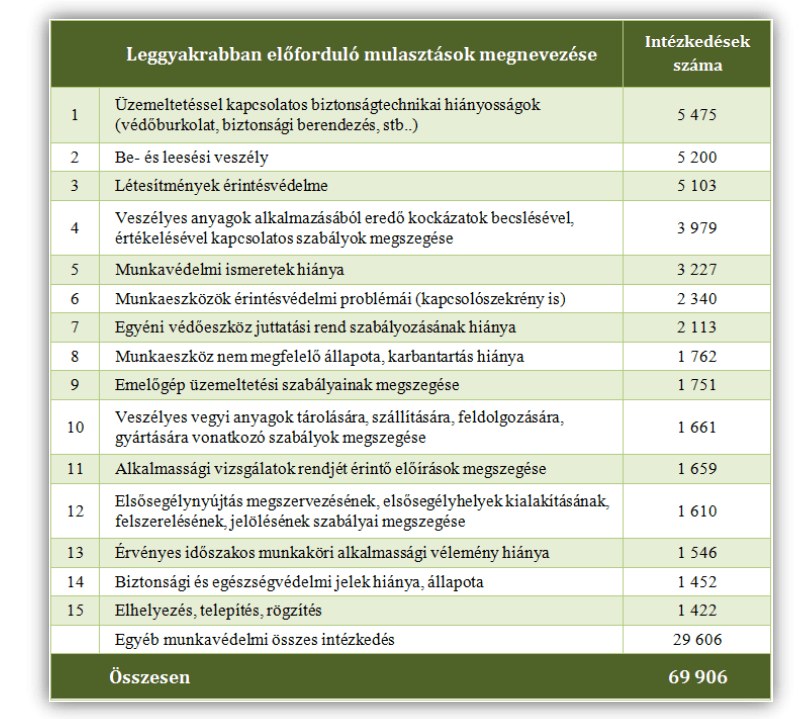
The most common occupational safety violations are listed in the table below:
Key occupational safety measures
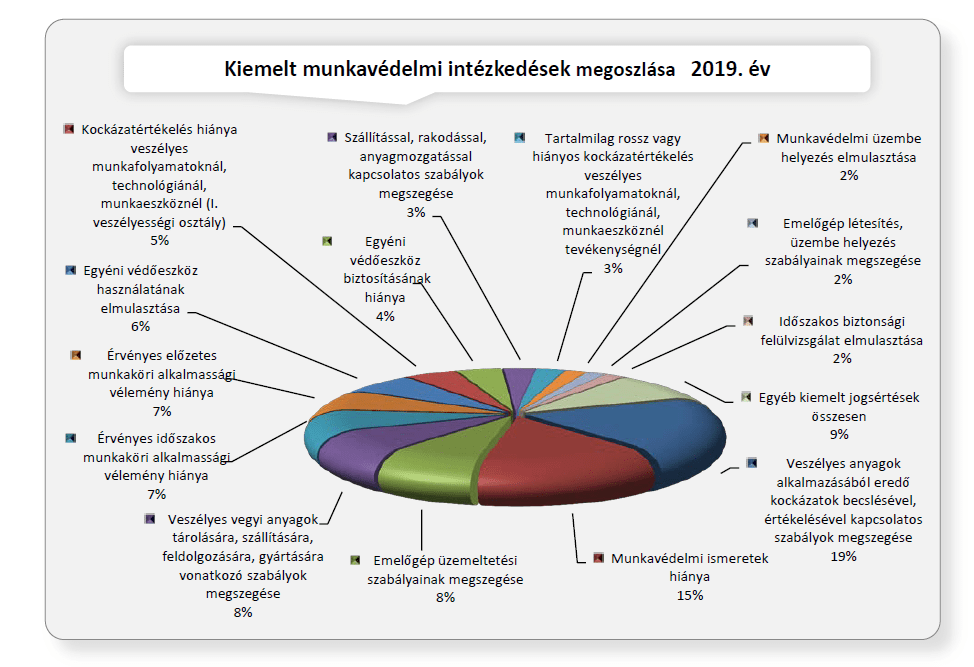
Overall, most measures (26.5%) were related to activities involving hazardous substances (including hazardous mixtures). The second most common deficiency (15.1%) was „Lack of knowledge about occupational safety” This was followed by 13.9% for failure to undergo medical examinations for job suitability. Of the deficiencies, 11% related to personal protective equipment and 10% related to lifting equipment.
Measures taken due to deficiencies in risk assessment account for 7.61% of all measures.
Key occupational safety measures
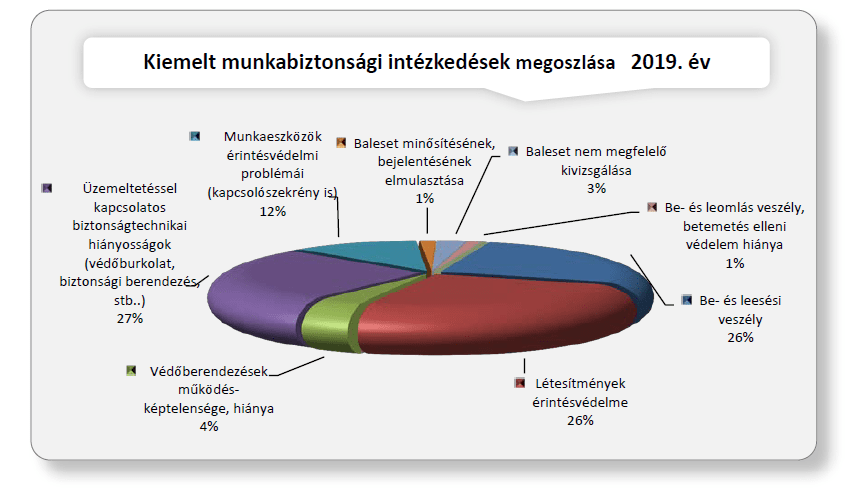
During 2019, among the priority occupational safety measures, government officials most frequently had to take action due to electrical safety deficiencies (37.2%). Numerous measures were taken due to the use of inadequate work equipment (31.3%). The proportion of measures taken due to inadequate investigation of work accidents or failure to report them was 4.2%.
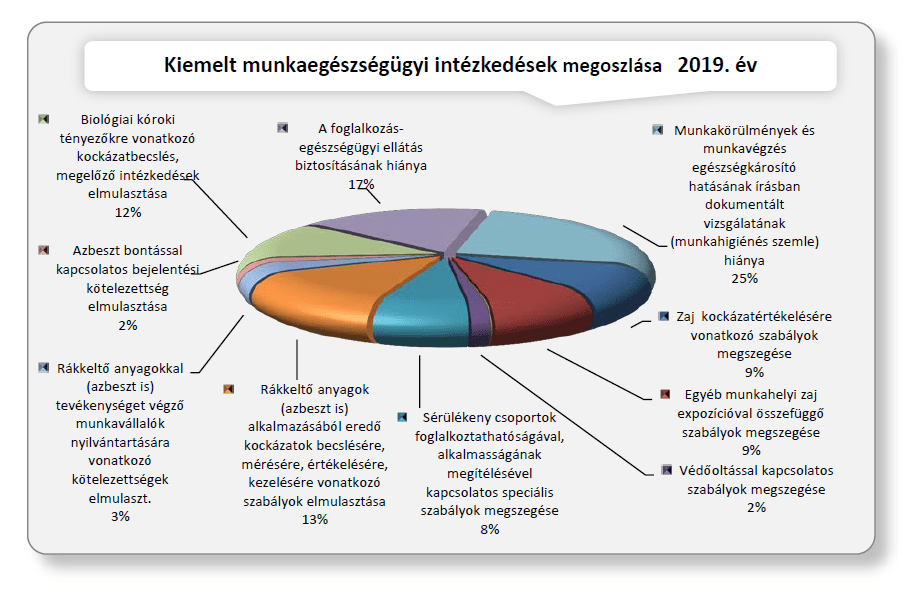
The most common deficiency is „Lack of written documentation of working conditions and the harmful effects of work on health” 24.8%. Because employers did not request occupational health services to conduct occupational health inspections. Occupational health inspections are to be performed by occupational health services, the assessment of the situation for the purpose of evaluating and managing (reducing) health risks, which may result in the introduction, modification, or improvement of preventive measures. Depending on the findings on site, this may be supplemented, as necessary, by instrumental tests to measure exposure to occupational risk factors (e.g., noise, vibration, workplace air pollutants, heat exposure).
Government officials still encountered employers who did not provide occupational health care for its employees.
A biological causative factors Measures taken in this regard account for a total of 13.71 TP3T of all priority occupational health measures. Particular attention should be paid to identifying irregularities related to biological risk factors, given that in recent years, health problems caused by microorganisms (viruses, bacteria, fungi, parasites, etc.) have accounted for a significant proportion of the occupational diseases reported, investigated, and accepted (registered) each year. In connection with the effects of climate change, the risk of infectious diseases (zoonoses) spread by vectors (animal intermediaries, e.g., insects, rodents) may also increase.
Numerous measures have been taken to occupational carcinogens 18.1% in relation to.
It often takes 10-50 years for clinically detectable cancer to develop, which is why both employers and employees tend to underestimate the dangers of working with such substances and the importance of complying with legal requirements. Keeping an exposure record of employees working with carcinogens can play a key role in reconstructing any cancerous diseases that may occur later.
Requiring special protection vulnerable groups of workers (minors, pregnant women, women who have recently given birth, breastfeeding mothers, elderly people, people with reduced working capacity) account for 7.8% of all priority occupational health measures.
Serious violations
In 2019, the serious violations It was typical that, in many cases, the shoring of work pits and trenches was neglected during civil engineering and public utility construction work.
In the construction industry, when working at height, the lack of adequate collective technical protection against falls, failure by the employer to provide personal protective equipment to protect against falls, or failure by the employee to use such equipment.
A without machine operator authorization (due to inadequate qualifications) most often arose in connection with material handling and storage (unauthorized use of lifting equipment and forklifts).
Machinery and equipment used in manufacturing, engineering, and agriculture often caused serious accidents in the Lack of protective covers and safety equipment to demarcate hazardous areas., or due to the elimination or failure to use them.
In the case of electrical equipment shortcomings in protection against direct and indirect contact was the most common hazard. Inadequate fastening of protective covers for electrical equipment and failure to protect electrical cables against mechanical impact occurred in many work areas.
Failure to conduct preliminary and periodic medical fitness examinations ranked among the most serious occupational health hazards. There was a lack of personal protective equipment providing adequate protection when working with hazardous substances/mixtures, and hearing protection was not provided or used in activities involving noise exposure exceeding the upper intervention limit.
Source: ommf.gov.hu